MEDIA OUTLET
Our media center features articles submitted by our subscribers as well as interviews with amateur hockey players, coaches, and those that have contributed to the growth of amateur hockey throughout the US and Canada
Tuesday, December 9, 2025
Unlock the secret to explosive speed and championship dominance on the ice! Step inside the mind behind PowerSk8r. Sean P. Halpin—a 30-year business owner, Level 4 hockey coach, aerospace and automotive design expert (think Ford Mustang innovations), and founder of HalpinSolutions.com. This powerhouse inventor took time from his rink-to-rink RV adventures to spill the beans on PowerSk8r: Amazon's #1 on-ice training aid, backed by over 30 state championships from just two Michigan coaches alone.
RTH: While in “development mode,” was there a specific “aha” moment from your own hockey experience or from observing young players that led to inventing skate weights for skating training?
SH:Yes. In 2004, while running the upper deck of the rink stadium to train for a marathon, I noticed 13 state championship banners hanging in the Superior rink in Fraser, Michigan. They all bore the name Tim Zimmerman. A week later, while training again, I saw some young players with black square blocks atop their skates. I called over to one of the kids and asked the coach’s name; they replied, “Tim Zimmerman.” I immediately realized he had the key—the “secret sauce”—to maximizing his players’ intensity in every practice. I reached out to Tim, and he was instrumental in inspiring the new, aerodynamic design you see today. Terry Brooks, another state-champion coach from Cranbrook, Michigan, also provided valuable inspiration during development. Currently, these two Michigan coaches have amassed over 30 combined state championships using PowerSk8r with their teams.
At the time, I was working as a designer in the Ford Mustang studio. You may notice that a hood scoop—a signature Mustang feature—runs down the center of the weight. The true secret lies in how I was inspired to develop that precise aerodynamic shape. We’ll keep that part quiet—SHHHHH!
RTH: Take us behind the scenes of bringing PowerSk8r to market. From initial sketches to the first production run, what was the biggest hurdle, and how did you overcome it?
SH:I’ve been an automotive designer for over 30 years and have worked in car studios around the world, collaborating with clay modelers to digitally create the shapes of next-generation vehicles. That made me an expert 3D modeler. The primary challenge was that the first version was too wide; children’s skates would strike the weights during crossovers. That design flaw cost me about $5,000. We fixed it by narrowing the profile, and the design has been successful ever since. We now use 3D scanning technology to capture exact skate shapes and sizes, and we incorporated specialized automotive development software called ICEM Surf, which is widely used in studios worldwide.
RTH: Can you walk us through the key design features of PowerSk8r—like the adjustable resistance and lightweight build—and explain how they ensure safe, effective training without compromising a skater’s natural technique?
SH:Once we nailed the optimal shape, we initially used only a strap. We quickly discovered that side-to-side and front-to-back movement was excessive. To solve this, we added a bungee cord and hook around the back to achieve what we call “cross-car, up-down, and fore-aft stabilization”—a little automotive design terminology.
RTH: How does PowerSk8r differ from traditional resistance training tools (like parachutes or sleds) specifically for ice hockey? What makes it uniquely suited for on-ice and off-ice drills?
SH:Traditional tools available to most coaches primarily build the posterior muscles of the thigh. PowerSk8r activates when the skate lifts off the ice, creating resistance during the forward recovery motion and thus developing the anterior (front) side of the thigh. PowerSk8r is the only training product explicitly designed to target the forward motion of the skate. The sensation can be simulated by anchoring a bungee cord under a table leg and pulling it forward. If a player repeats this motion 2,500 times per foot in a single practice, they have effectively generated the resistance equivalent of moving an extra 5,000 lbs during that session.
RTH: For youth and junior players, what measurable improvements have you seen (or heard from users) in edge work, acceleration, and endurance after using PowerSk8r?
SH:PowerSk8r consistently improves speed, endurance, balance, and strength. When we used a stopwatch to record fast-lap times with NHL players, we documented 10–35% speed increases in 30-, 60-, and 90-second bursts. It’s really important to do the fast-lap test right before playoffs. I would always give awards to the five most-improved players. The kids’ confidence would explode! They went into playoffs with a new spark, knowing they were faster. Usually the slowest kids at the beginning of the season showed the biggest lap-time improvements.
RTH: How do you recommend youth players progress with PowerSk8r—from beginner resistance levels for edge-work drills to advanced setups for full-ice sprints—and what common mistakes should they avoid to maximize gains without causing fatigue?
SH: I frequently see skaters with a very high “runner’s stride” during recovery back to center. That large circular motion is not efficient; the shortest path between two points is a straight line. A low, tight recovery—just above the ice and without the big circular motion—improves stride efficiency instantly, even without the weights.
RTH: Beyond on-ice sessions, how can amateur teams incorporate PowerSk8r into off-season or gym-based workouts, and do you have tips for pairing it with other tools like slide boards or agility ladders?
SH: Any supplementary exercise helps. The most foundational (and often overlooked) is the wall sit. My teams did wall sits to muscular failure every night before dinner—no food until it was complete. That alone dramatically improved strength and stamina. Riding a bike in the neighborhood and alternating 30-second sprints with 30-second recovery is also excellent for third-period energy. When Kevin Hatcher retired, his son Cole joined our preseason training at the Olympic Velodrome in Rochester, Michigan (the one with the steep banked walls). The kids were terrified at first, but they all ended up loving it.
RTH: As a small-business owner, what’s one unexpected lesson you’ve learned about serving the hockey community since launching PowerSk8r?
SH:My most persistent operational headache is in Canada—the weights constantly “disappear” from inventory, forcing me to file lost-package claims every quarter. I suspect (but can’t prove) that hockey dads who work at big retailers snag them to train their own kids. I’ve also had US Mail carriers deliver empty boxes because the package was too heavy to carry on foot. And then there was the time Facebook/Instagram unilaterally shut down @thepowersk8r without explanation and ignored every appeal. Overnight I lost 5,000+ followers, all my influencers, and years of brand-ambassador work. It was like someone ripping the sign off my storefront. Small-business support on that platform is basically nonexistent.
RTH: What’s the most inspiring success story you’ve received from a young player or parent using PowerSk8r?
SH:I’ve followed a handful of kids for over ten years. Ryan and Aydan Nickols started using the weights in Chicago at ages 8 and 10 (they’re in the video on the website). Both were later recruited to the Junior Flyers (Philly). Curtis Halpin, now in the Penn State system, was known for years as the fastest player in North Carolina and led his U18 team to Nationals four years ago. He was famous for back-checking breakaways, executing perfect stick lifts, and sending the crowd wild. Every year I still get messages from coaches across the country whose entire teams use PowerSk8r and just won their state championship.
RTH: In your view, how does a tool like PowerSk8r fit into the bigger picture of modern hockey development, especially with the rising emphasis on skill-specific training at non-pro levels?
SH:It’s a universal truth: the team that skates better wins. In the first half of every season I coached, I would intentionally sacrifice playmaking development to focus relentlessly on skating technique and speed—we often lost games early. But by the second half, once we added playmaking on top of superior skating, we crushed the same teams we’d lost to earlier. Opposing coaches would ask, “Is this the same team?” I’d just laugh and say, “Yes!” Too many teams waste practice time standing in line. Keep them moving, correct technique individually, and build superior team skating—then playmaking becomes easy.
RTH: Looking at Halpin Solutions’ focus on innovative product design, how do you see PowerSk8r evolving—perhaps with goalie or position-specific variants—to support players at non-pro levels?
SH:I’m finally launching the long-overdue 2.5 lb PowerSk8r-Pro this season for high-school, college, and pro players who outgrew the original. Jamar Jajar trained his entire career with 5 lb weights and was one of the oldest players in the NHL alongside Chris Chelios (his daughter played on my championship girls travel team—great team parties at Cheli’s Chili in Dearborn!). The only player I ever coached who reached the NHL was Blue Jackets goalie Cam Johnson; he was 12 and on my roster briefly. He played in NHL games between 2021 and 2023.
RTH: When you’re not inventing the next big thing, what do you enjoy doing in your leisure time?
SH:I’m currently living full-time RV life. We just left Yosemite, and six months in, my YouTube channel ZeroMPHlife is all about the lifestyle. I still travel rink to rink staying active in the industry. www.halpinsolutions.com is the main site. I continue to get word-of-mouth car-design consulting gigs and have an office in my 40-foot rig (I removed the kitchen to make room). I also help inventors take ideas from napkin sketch to Shark-Tank-ready (I got inventor Larry Kelly into the top five on the Golf Channel’s FORE Inventors show). If you ever have a million-dollar product idea, save my number as “Inventor Guy”: 586-243-2240.
────────────────────────
Step inside the mind of a Tournament/Camp Director and find the answers to the questions you’ve always had about these events. Read our full interview with Canadian Hockey Enterprises founder and president, Paul Crowley. Paul is happily married and proud to say he has 3 children, 5 grandchildren, 1 step-grandson, and a cat.
RTH: CHE has been running tournaments and camps since 1987—what’s the original spark that made you say, “Let’s build the world’s biggest hockey experience company”?
PC: That’s a good question. As a former AHL player for 7 years, plus another 2 years in multiple other leagues (WHA, SHL, NAHL), I was always grateful for my career. Still, I felt like I played second fiddle to the players in “The Show.” I wanted to make the big time in another way — through my business!
RTH: With over 750 teams hitting the ice at CHE events every year, what’s the secret to keeping every weekend—whether in Lake Placid, Banff, or Vegas—feel like a once-in-a-lifetime trip for players and families?
PC: I think you have to treat customers like family. Our full-time and part-time staff have been with CHE for decades, and we know our customers well. Even in today’s technical world, we want to connect, treat our customers with respect, and be just normal people. We treat our Zamboni drivers, customers, and staff like one big family — everyone matters. Being humble and genuinely interested in others’ lives is fundamental to our success.
RTH: You host men’s, women’s, boys’, and girls’ tournaments across 17 destinations. How do you tailor the vibe so a U12 team in Montreal has just as much fun as a 40+ men’s squad in Nashville?
PC: They’re different experiences. The youth market has different needs than the adult market, and you have to cater to those needs — period. We understand that.
RTH: The “Just for Girls” camps are a standout program. What feedback do you hear most from parents and players about why these exclusive environments accelerate skill and confidence?
PC: CHE started the first “Just for Girls” camps in 2002, right after the Salt Lake City Olympics. We saw a huge shift in women’s hockey after its inclusion at the 1998 Nagano Olympics, and the momentum exploded following Salt Lake City in 2002. We capitalized on it, pivoted quickly, and have continued doing the same with female-only tournaments ever since.
RTH: Girls’ and women’s hockey is exploding. How is CHE expanding tournament divisions, ice time, and exposure to keep pace with the surge in talent?
PC: When you diversify in location, country, boys & girls, men & women, it always works itself out. There’s usually a strong fit for female tournaments and camps. The market dictates that.
RTH: All-inclusive tournament packages are a bit of a rarity in this business. How do you feel the "all-inclusive" format stacks up against, traditional tournament weekends?
PC: It’s our bread and butter. Once teams understand the concept, they love the service we provide. Our locations lend themselves perfectly to an all-inclusive model. We intentionally choose holiday destinations, which make our tournaments ideal for bundled hotel and meal packages.
RTH: CHE welcomes teams from Europe and beyond—any wild stories of international rivalries or friendships that started on your rinks and still continue today?
PC: The biggest rivalry has always been Canada vs. USA — whether kids or adults! CHE is incorporated in both Canada and the USA, so we have a healthy respect for the two countries. Playing European countries can be feast or famine. Quite often, Euro teams will stack their old-timer rosters with ex-national-level players and crush our beer-leaguers, but it doesn’t happen often. At the end of the day, there are always a few brews shared, and all is good!
RTH: The new CHE Academy at the Miskin Law Community Complex just opened its doors. Walk us through a day in the life of a student-athlete balancing elite hockey with top-tier academics. PC: We’ve been working on an academy for the last 5 years. There has been a huge shift in how people view hockey development in Canada — from rogue spring leagues to full-time academies — and Hockey Canada is finally changing its thinking and allowing academies to have a legitimate place. I think there were too many limitations on where kids could play and where they truly fit. Some kids are late bloomers and will thrive in an academy environment that offers on- and off-ice discipline. Others want to train and practice during the day so they can focus on school at night and play most of their games on weekends. The USA has been the leader in this model for decades, and Western Canada has led the way inside our country. It’s now spreading east, and we want to be part of the positive evolution of hockey in Canada — giving kids a place to study, play high-level hockey, and feel part of a real community. The market is definitely there. We have an amazing staff, and we can’t wait to launch our U18 team for the 2026–27 season.
RTH: With a multitude of teams from both USA Hockey and Hockey Canada competing in CHE events, what steps do you take to ensure fair and balanced divisions?
PC: The adults are usually the most difficult — every adult team swears they’re old and “used to be good”! Don’t worry; after 38 years, we don’t fall for that anymore. LOL. We have a proven formula, and our full-time staff and tournament directors know exactly how to handle it. Youth placement is all posted online and just a matter of interpreting the terms and language — for example, a Tier 1 player in one area might be equivalent to a AAA player somewhere else.
RTH: If a young player or parent is on the fence about their first CHE experience, what’s the one thing you’d tell them they’ll take home that no other hockey company can match?
PC: It’s hockey — enjoy the experience. There are two nets, a bunch of blue and red lines, one puck, refs, and teammates. It’s meant to be fun. It’s meant to promote healthy competition and camaraderie. It’s meant to develop teamwork. Unfortunately, a few bad-apple parents can ruin it for everyone. The arena and watching your son or daughter play is a place to cheer and enjoy the moment — most parents get that right. At CHE, we have enormous respect for the game and everything it has given us in our lives. I can assure you we don’t let idiots, abuse, or violence ruin the experience for the kids. We will stop games and remove people from arenas the moment they cross the line. It’s a very easy decision for CHE!
We have good people — good citizens and family-oriented people — who run our events. We get it, and you can feel that confidence the second you walk into a CHE tournament.
RTH: With the 2025-26 season underway, any hot destinations or new divisions you’re rolling out that teams should mark on their calendars right now?
PC: For youth, we have Mont Tremblant, Quebec in December and Jasper, Alberta in November and January. They fit perfectly into our collection of top-notch vacation and hockey destinations.
RTH: In a nutshell, what can a new team, spending a tournament weekend with CHE, expect to experience?
PC: We’ve heard kids and adults alike say that CHE weekends are the highlight of their year — whether it’s the hockey or the destination. That’s exactly how we want our customers to feel. We understand that a happy customer comes back. It’s simple math. I’d be lying if I said we’ve never had unhappy customers — of course we have — but it’s how we fix problems that truly defines us.
I’d be remiss if I didn’t mention our long-standing, full-time team that makes it all possible: Glen Forbes, our GM for 37 years; Chad Cavanagh, our Senior Hockey Director for 20 years; young stars Kurt Hyland and Ken Shepard; Erin Crowley, the rock of our administration department; south of the border, long-time USA Hockey Director Mike McCabe; our newest Quebec administrator Jacob Giroux-Lamont; and out west, our dedicated tournament directors led by Craig Ryckman, including Blaine Shackleton, Murray Price, Ian Strachan, and Brent Sauer.
We are ready to welcome everyone to the CHE family!
RTH: I'd say that most of your life revolves around the sport of hockey. Away from the rink, what other activities do you enjoy in your leisure time?
PC: Personally, I’m a big foil-board rider behind our boat, and I wing-foil and kite-foil on Lake Okanagan or in Mexico whenever I can. All of our staff are avid golfers, which makes for some fun (and fierce) competition. I do know that my team — myself, Ken Shepard, and Graydon Crowley — handily beat Chad Cavanagh, Kurt Hyland, and Mike McCabe in this year’s grudge match. They tried their best… LOL!
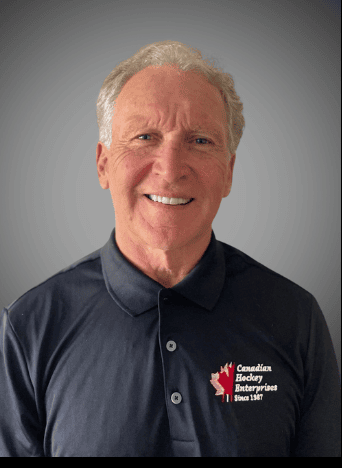
Founder and President of Canadian Hockey Enterprises, Paul Crowley has left a lasting legacy following a successful playing career. Selected by the Toronto Maple Leafs in the 1975 NHL Entry Draft, Paul played professionally for a decade, including 7 seasons in the AHL, setting the record for most consecutive games played, while serving as captain of both the Binghamton Whalers and Rochester Americans. Post playing, Paul scouted for both the New York Rangers and notably the Detroit Red Wings, helping Detroit capture Stanley Cups in 1997 and 1998. Paul served as Assistant Coach of the Barrie Colts, who won the J. Ross Robertson Cup in 2000.

We sat down with Weekend Hockey Owner and Tournament Director, James Zitmanis for a little Q & A session. Weekend Hockey hosts tournaments all over North America for both boys and girls, as well as adults.
___________________________________________________
Thursday, June 19, 2025
RTH: How long has Weekend Hockey been in business?
JZ: Weekend Hockey started in July of 2006. We will be in our 19th year this July 2025.
RTH: What made you get started in the youth hockey tournament business?
JZ: Since I was a young boy, my dream was to work in a sports related profession. My favorite sport is hockey. This profession is a a dream come true.
RTH: What would you say sets Weekend Hockey apart from other Tournament Directors?
JZ: I would say the following:
- In addition to all the awards, apparel we offer, we offer all teams an opportunity to play teams that they normally don’t play from out of state, Canada & Europe
- We offer digital creators at several of our tournaments to enhance the ‘Tournament Experience’ These people will interview many players, adding a super fun atmosphere
- Very well-balanced divisions. We look at MHR(My Hockey Rankings) team records to ensure competitive balance
RTH: We all know that it's not possible to create divisions that are 100% fair and I'm sure that you've had to deal with angry parents, coaches, and Team Managers at times. What measures do you take to organize divisions that are as fair as possible? What do you want people to know about the challenge of doing such?
JZ: As mentioned above, well-balanced divisions are a must. We always look at MHR(My Hockey Rankings) and team records to ensure competitive balance. If necessary, we will, for example, move an AA team up to an A level of 1 year older if we can’t fulfill a division of the same year of birth.
RTH: How do you ensure that officiating is fair and consistent across all games?
JZ: Officiating is one aspect of tournaments we have no control of. We expect all officials to do the best they can, arrive early & be as professional as they can. Of course, officials will always miss calls and also make great calls. All we can hope for is the parents don’t lose their minds when an official makes a call that doesn’t go their way.
RTH: You host tournaments as far north as Barrie, ON. As far south as Fort Lauderdale, FL. How do you go upon selecting venues and locations for your tournaments?
JZ: We like to offer locations that offer teams opportunities to experience another event or place. Such as an NHL, AHL, ECHL, College hockey game or NFL, NBA, NLL game. We also like to offer warm destinations such as Florida & Las Vegas or an outdoor venue that can offer an outdoor game experience.
RTH: What strategies do you use to promote your tournaments and keep repeat participants in Weekend Hockey events?
JZ: We do advertise extensively but we also depend on returning customers. When you can operate a great tournament teams will return & try other locations you offer.
RTH: How do you manage logistics like hotel accommodations and transportation for traveling teams?
JZ: We use a 3rd party hotel service that provides hotels for all out-of-town teams. We also offer assistance for teams that need transportation from their hotel to the arena.
RTH: What’s the most inciteful advice that you've received from your participants to make your tournaments better?
JZ: I would say we used to have games starting at 7am on Sat & Sun & finishing by 11pm. We now have all the games starting at 8am or 9am & all games finish by 10pm. This enables better scheduling for everyone.
RTH: What innovations or improvements are you planning for future events?
JZ: We are always looking for ways to improve. Always adding another feature or experience year after year. Example we have digital creators at several events. Eventually we will have these creators at all events.
RTH: What would you tell a coach or Team Manager that has never participated in a Weekend Hockey tournament?
JZ: I would say be prepared for the most fun, organized event you have ever been able to participate in.
RTH: What does James Zitmanis do outside of the youth hockey world?
JZ: I love to spend time with my family, golfing, travel & spend time at home barbecuing
RTH: Anything you'd like to add?
JZ: I would say the best advice for any team looking to participate in any tournament is to see which teams are currently registered. See how fast tournament staff return your email or phone call & look at last year’s results. And finally see how long the tournament has been operating
James and his wife, Susan reside in Oakville, ON with their dog Tayto. They have six children: Zack, Lucas, Thomas, Julie, Katie, and Amy

Larry Ollearis, owner of All Black Hockey Sticks and Just Hockey Jerseys, sat down with us to talk about his products and his hockey career. Without further ado....
__________________________________________________
Friday, April 14,2023
RTH: What kind of background did you have prior to starting ABHS?
RTH: Where did the idea for this whole hockey stick thing come from?LO: We saw a need to allow players to have an affordable means for a top end product. They charge "Joe Hockey" high prices and give top players and teams a great deal did not make sense to us. So we went after a light stick that would not cost the car payment or even part of the mortgage when buying. Even worse when they break, ours break cheaper!
RTH: We know that you offer lots of different lies and curves with your sticks. Is there a particular age or level that your sticks are better suited for?
RTH: A lot of people might think ABHS just sells hockey sticks. What other types of items can you buy on the ABHS website?
RTH: Unfortunately, we lost quite a few businesses during the "COVID era". Do you feel the hockey industry, as a whole, has started to recover from the pandemic?
LO: We did dip like all businesses during the pandemic. We have seen numbers grow on our side past prepandemic numbers in both sticks and Jerseys. So yes we have seen a great turn around.
RTH: When I played hockey as a youngster, we used wooden sticks made by 3 or 4 different companies. There are now stick manufacturers popping up everywhere. What is the hardest part about staying ahead of the competition in this very comptetitive business?
RTH: Rezztek is your newest product. What are the benefits of using Rezztek Blade Grip as opposed to traditional hockey tape on your blade?
RTH: You're also heading up the brand Just Hockey Jerseys. Can you tell us a little bit about what JHJ has to offer(types, styles, materials, etc)?LO: We did start the jerseys years ago. Mostly to use for ourselves and just a few teams local. But last couple of years we moved it to its own brand. Same theory is to to offer an affordable sublimated option. Kids teams, beer league, even some higher level teams for speccialty nights we run $35 w/a 7" sponsor logo. We have some great designers we work with to help players develop their idea into something the team will enjoy. When you can get jerseys and socks for $47.50 it makes it easier on the teams.RTH: I run out and grab a pack of hockey cards and get a "Larry Ollearis" card. What does your hockey career summary look like on the back of the card?LO: Who? No history there barring beer league! Have had chances to play all over though with so many teams and tournaments who said come on down with the trailer and you can play on our team. So the career summary would just be filled with pictures of the different team pictures that have helped this company grow.RTH: We'd like to thank Larry for taking time out of his busy schedule to talk to us. It was a pleasure. Be sure to check out ALL BLACK HOCKEY STICKS and JUST HOCKEY JERSEYS for some great quality and savings!
.jpg)
Our interview with Anthony Raco, Head Coach of the 2018 AAA Penguins Cup Champion, Seneca Valley Raiders. Anthony played his youth hockey with the Mt Lebanon Hornets followed by club hockey with the Edinboro University Fighting Scots. He has coached with Seneca Valley for 10 years now at the middle school, JV, and Varsity levels.
__________________________________________________
Friday, July 20, 2018
RTH: First and foremost, congratulations on bringing Seneca Valley their first ever Penguins Cup championship. What does bringing the Cup to SV mean to you as a coach?
AR:It’s a personal goal I set out when I became the head coach for the varsity program. My first 2 years the varsity team lost both Pens Cup Finals back to back years. I wanted to be a part of bringing a championship to the program and be able to put SV on a list of great teams who have won a title. We as coaches put a lot of work in and demand a lot from our players. It was a lock in moment being able to see a different demeanor from my players being able to be on the upside for once.
RTH: Given that SV gave up a total of 35 goals during the 2017-18 PIHL season, you are, obviously, a defensive-minded coach. Where and why did you adopt this defensive philosophy?
AR: When I think of defense its not just in our Dzone. I want my players to understand defense in every zone. Whether you are on a forecheck in their end you have to understand when to be aggressive and when to know to give up the zone and then to begin to play defense in the neutral zone. Its all about layers and everyone being able to understand their roles in certain situations. I make sure I do a lot of film study with our guys so they know what they are about to face and I think that transitioned well for us.
RTH: With the 2018-19 season nearly upon has, which players are you banking on leading this team to a potential Penguins Cup repeat?
AR: Tyler Draper is going to have a big role this year. He is the only returning captain that was on the roster from last year. He has a lot of skill and he has really developed and changed his game and I expect big things from him. Bryce Korner on the defensive end was really good for us last year. Michael Spokane who is going to be a junior led us in goals last year and he has the drive and skill to really have a positive effect on the locker room.
RTH: Heading into the 2018-19 season, what other teams are you looking at to challenge you for next years Penguins Cup?
AR: Its hard to say because AAA points are tight every year. So there is a lot of respect for all the teams within the classification. There are a lot of great coaches whom I respect highly. Each game is competitive and you can’t overlook anyone especially in the playoffs.
RTH: Meadville's, Jamie Plunkett, is entering his 32nd year as Head Coach of the Bulldogs and has amassed over 1000 wins. Do you see yourself staying with SV for an extended run or do you have interest in advancing to a higher level of hockey?
AR: Right now I love my time here at SV and have plans to remain here for a long time. High school hockey provides me to be able to balance hockey and family the best right now. I've had nothing but a great experience here at SV and want to win more titles and aim for a State title. If hockey could lead to higher levels for me it probably wouldn’t be until the time was right.
RTH: What would you say your biggest weakness as a hockey coach is?
AR: Its tryouts. I'm a teacher and a high school coach. So when what you chose as a career is working with kids you want to see them all succeed. SV is a pretty big school and we have 5 teams. It’s hard when you have to turn kids away or a senior doesn’t make the varsity team. You have to put the right kids on the right team. Some of the conversations after tryouts are hard and you try to be as supportive as possible.
RTH: Other than the Penguins Cup championship, what is your most memorable experience as a coach?
AR: Probably every time that I run into a former player after they graduate. Coaching is about forming bonds with your players. Not just for when they play for you but after as well. I keep in touch with quite a few or its always nice to catch up. I was blown away by all the messages I got from former guys after we won. That was special.
RTH: What is your advice to younger squirt and pee wee aged players in order for them to perhaps one day play High School or even Tier 1 hockey?
AR: Keep being motivated and keep creating goals for yourself. Keep trying to get better. Make skating your craft. This is what separates good players and elite players. Study study study. The internet is a huge library for players to go to for information on how to become a smarter player. Hockey is speed and IQ.
Anthony resides in McCandles Twp, PA with his wife, Amy, and 3 kids Mia(9), Khloe(6), and Easton(3)